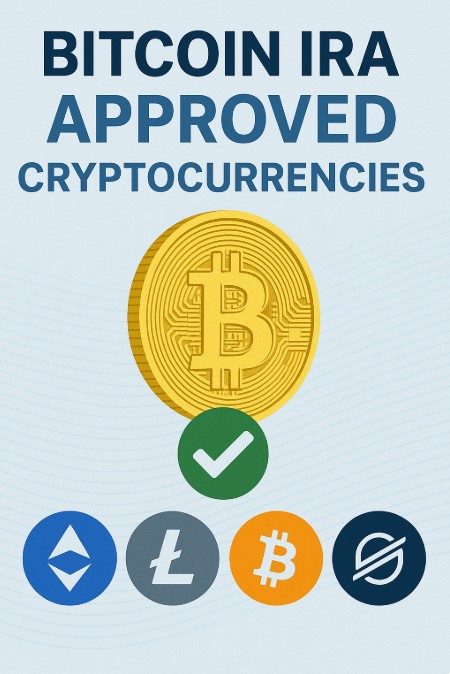
Bitcoin IRA Approved Cryptocurrencies: Complete Guide to Retirement Crypto Options
Comprehensive guide to Bitcoin IRA approved cryptocurrencies, including Bitcoin, Ethereum, and other eligible digital assets for your retirement portfolio.
What Are Bitcoin IRA Approved Cryptocurrencies?
Bitcoin IRA approved cryptocurrencies are specific digital assets that meet the requirements for inclusion in self-directed Individual Retirement Accounts, as determined by both IRS property classification and individual Bitcoin IRA provider policies. Unlike the strict purity standards for precious metals, cryptocurrency eligibility depends on factors like regulatory clarity, market liquidity, security infrastructure, and the custodian's ability to safely store and manage the digital asset.
Since the IRS classified Bitcoin as property in 2014, it became eligible for IRA inclusion, opening the door for other established cryptocurrencies to follow. However, not every cryptocurrency qualifies for retirement account inclusion. Bitcoin IRA providers like iTrustCapital, Bitcoin IRA, and BitIRA maintain curated lists of supported digital assets, focusing on established cryptocurrencies with strong track records, regulatory clarity, and robust security infrastructure.
The selection process involves rigorous evaluation of each cryptocurrency's technology, market adoption, regulatory status, and long-term viability. This careful curation protects retirement investors from highly speculative or potentially problematic digital assets while providing exposure to the most established and promising cryptocurrencies in the market.
Primary Bitcoin IRA Approved Cryptocurrencies
Bitcoin (BTC) remains the cornerstone of most Bitcoin IRA portfolios and is universally supported by all major providers. As the first and largest cryptocurrency by market capitalization, Bitcoin offers the highest liquidity, broadest acceptance, and most established regulatory framework. Its finite supply of 21 million coins and role as "digital gold" make it particularly appealing for retirement portfolios seeking long-term store of value characteristics.
Bitcoin's institutional adoption by companies like Tesla, MicroStrategy, and El Salvador, combined with the approval of Bitcoin ETFs by the SEC, has solidified its position as the primary cryptocurrency for retirement investing. Most Bitcoin IRA investors allocate 40-70% of their cryptocurrency holdings to Bitcoin due to its established track record and relative stability compared to other digital assets.
Ethereum (ETH) has emerged as the second most popular choice for Bitcoin IRA investing, supported by virtually all major providers. Beyond serving as a cryptocurrency, Ethereum functions as the foundation for smart contracts, decentralized applications, and much of the decentralized finance ecosystem. This utility gives Ethereum value propositions beyond simple store of value, making it attractive for investors who want exposure to blockchain technology's broader applications.
Ethereum's transition to proof-of-stake consensus through "The Merge" in 2022 addressed many environmental concerns and improved its long-term sustainability. The ongoing development of Ethereum 2.0 and its role in supporting thousands of decentralized applications make it compelling for retirement investors seeking exposure to blockchain innovation.
Litecoin (LTC) is widely supported across Bitcoin IRA platforms due to its long history, technical stability, and position as "silver to Bitcoin's gold." Created by former Google engineer Charlie Lee, Litecoin offers faster transaction times and lower fees than Bitcoin while maintaining similar security principles. Its established track record since 2011 and conservative development approach appeal to retirement investors seeking proven technology.
Bitcoin Cash (BCH) emerged from a 2017 Bitcoin fork focused on increased transaction capacity and lower fees. Many Bitcoin IRA providers support Bitcoin Cash due to its shared history with Bitcoin, established infrastructure, and focus on peer-to-peer electronic cash functionality. While more controversial than other options, its inclusion provides exposure to alternative approaches to Bitcoin's scaling challenges.
Additional Supported Cryptocurrencies
Beyond the primary four, many Bitcoin IRA providers support additional established cryptocurrencies that meet their criteria for security, liquidity, and regulatory clarity:
Chainlink (LINK) is frequently supported due to its critical role in connecting blockchain networks to real-world data. As the leading decentralized oracle network, Chainlink enables smart contracts to access external information, making it fundamental infrastructure for the broader blockchain ecosystem. Its utility and partnerships with major enterprises make it attractive for long-term retirement portfolios.
Stellar (XLM) appears on many Bitcoin IRA platforms due to its focus on cross-border payments and financial inclusion. Developed by Ripple co-founder Jed McCaleb, Stellar aims to bridge traditional financial systems with blockchain technology. Its partnerships with established financial institutions and focus on regulatory compliance align well with retirement account requirements.
Cardano (ADA) is supported by some providers due to its academic approach to blockchain development and focus on sustainability. Founded by Ethereum co-founder Charles Hoskinson, Cardano emphasizes peer-reviewed research and formal verification methods. Its proof-of-stake consensus mechanism and focus on regulatory compliance appeal to conservative retirement investors.
Other cryptocurrencies occasionally supported include Polkadot, Solana, and select DeFi tokens, though availability varies significantly by provider and changes based on market conditions, regulatory developments, and security considerations.
What Cryptocurrencies Don't Qualify?
Bitcoin IRA providers maintain strict exclusion criteria to protect retirement investors from excessive risk and regulatory uncertainty:
Privacy Coins like Monero, Zcash, and Dash are typically excluded due to regulatory concerns. While these cryptocurrencies serve legitimate privacy purposes, their anonymity features create compliance challenges that most Bitcoin IRA providers prefer to avoid. Regulatory agencies have expressed concerns about privacy coins' potential use in money laundering and tax evasion.
Meme Coins and Speculative Tokens such as Dogecoin, Shiba Inu, and various trending tokens are generally excluded due to their speculative nature and lack of fundamental utility. While some of these assets have achieved significant market capitalizations, their volatility and lack of underlying value propositions make them unsuitable for retirement investing.
New and Unproven Cryptocurrencies are typically excluded regardless of their technology or promises. Bitcoin IRA providers focus on established assets with multi-year track records, substantial market capitalizations, and proven security. New cryptocurrencies, regardless of their potential, require time to demonstrate stability and regulatory acceptance.
Stablecoins like USDC, USDT, and DAI are generally not supported, despite their stability, because they don't offer the growth potential that retirement investors typically seek from cryptocurrency exposure. Since stablecoins are designed to maintain stable values relative to fiat currencies, they serve different purposes than growth-oriented retirement investments.
DeFi Tokens and Complex Derivatives are typically excluded due to their complexity, regulatory uncertainty, and additional risks. While decentralized finance represents an important blockchain innovation, most DeFi tokens involve complex mechanics and regulatory gray areas that make them unsuitable for retirement accounts.
Why Provider Selection Matters
Different Bitcoin IRA providers support different cryptocurrencies, making provider selection crucial for investors with specific digital asset preferences:
iTrustCapital supports a focused selection of major cryptocurrencies, emphasizing Bitcoin and Ethereum while including select alternatives like Litecoin and Bitcoin Cash. Their conservative approach appeals to investors who prefer established assets with long track records.
Bitcoin IRA typically offers broader cryptocurrency selection, supporting 10-20+ different digital assets including both major cryptocurrencies and selected altcoins. This diversity appeals to investors seeking broader crypto exposure within their retirement accounts.
BitIRA focuses on institutional-grade security and typically supports a curated selection of established cryptocurrencies with emphasis on regulatory compliance and long-term viability.
Before choosing a provider, evaluate their supported cryptocurrency list against your investment goals, risk tolerance, and desired portfolio allocation. Some investors prefer providers with extensive options, while others value more conservative, focused selections.
Security and Custody Considerations
Bitcoin IRA approved cryptocurrencies must meet stringent security and custody requirements that protect retirement investors:
Cold Storage Requirements ensure that approved cryptocurrencies can be securely stored offline in institutional-grade facilities. Cryptocurrencies that cannot be properly secured through established custody solutions are typically excluded from Bitcoin IRA platforms.
Multi-Signature Security capabilities allow for enhanced security through multiple authentication requirements. Approved cryptocurrencies must support security protocols that meet institutional standards for protecting large-value holdings.
Insurance Coverage extends to approved cryptocurrencies through custodial arrangements. Bitcoin IRA providers typically maintain insurance policies covering digital assets, but coverage may vary by cryptocurrency and storage method.
Regulatory Compliance ensures that approved cryptocurrencies meet current and anticipated regulatory requirements. Providers regularly review their supported assets to ensure ongoing compliance with evolving regulations.
Tax Implications and Benefits
Bitcoin IRA approved cryptocurrencies offer the same tax advantages as other IRA investments, but with unique considerations:
Tax-Deferred Growth in traditional Bitcoin IRAs means that approved cryptocurrency gains aren't taxed until withdrawal. This can be particularly valuable for high-growth assets like Bitcoin and Ethereum, where substantial gains can compound without immediate tax consequences.
Consider Jennifer's experience: she invested $25,000 in approved cryptocurrencies through her traditional Bitcoin IRA in 2020. By 2024, her portfolio had grown to $75,000. In a taxable account, she would owe capital gains taxes on the $50,000 profit, but in her traditional IRA, the entire amount continues growing tax-deferred until retirement withdrawal.
Tax-Free Growth in Roth Bitcoin IRAs can be even more powerful for approved cryptocurrencies with high growth potential. Since cryptocurrency gains in Roth IRAs are never taxed upon qualified withdrawal, the tax savings can be substantial for successful long-term investments.
Contribution Limits and Rules apply equally to all approved cryptocurrencies within Bitcoin IRAs. The same annual contribution limits, required minimum distributions, and withdrawal rules apply regardless of which approved cryptocurrencies you choose for your portfolio.
Investment Strategies with Approved Cryptocurrencies
Successful Bitcoin IRA investing often involves strategic allocation across multiple approved cryptocurrencies rather than concentrating in a single asset:
Core-Satellite Approach involves allocating the majority of cryptocurrency holdings to established "core" assets like Bitcoin and Ethereum, while using smaller allocations to "satellite" cryptocurrencies like Litecoin or Chainlink for additional diversification.
A typical allocation might be 60% Bitcoin, 25% Ethereum, 10% Litecoin, and 5% in other approved cryptocurrencies. This approach provides exposure to cryptocurrency's growth potential while managing risk through diversification among established assets.
Dollar-Cost Averaging works particularly well with approved cryptocurrencies due to their volatility. Regular investments over time can help smooth out price fluctuations and reduce the impact of market timing on long-term returns.
Rebalancing Strategies help maintain target allocations as different approved cryptocurrencies perform differently over time. Periodic rebalancing ensures your portfolio doesn't become overly concentrated in any single cryptocurrency due to performance differences.
Future Evolution of Approved Cryptocurrencies
The landscape of Bitcoin IRA approved cryptocurrencies continues evolving as the digital asset market matures and regulations clarify:
Regulatory Clarity will likely expand the list of approved cryptocurrencies as government agencies provide clearer guidance on digital asset classification and compliance requirements. Cryptocurrencies currently excluded due to regulatory uncertainty may become eligible as clarity emerges.
Institutional Adoption of additional cryptocurrencies by major financial institutions and corporations could lead to their inclusion in Bitcoin IRA platforms. As more cryptocurrencies gain institutional acceptance, they become more attractive for retirement account inclusion.
Technology Maturation and improved security infrastructure for newer cryptocurrencies may enable their eventual inclusion in Bitcoin IRAs. As custody solutions and security protocols develop, previously excluded cryptocurrencies may meet the standards required for retirement account inclusion.
Market Evolution will continue shaping which cryptocurrencies remain viable for long-term retirement investing. The cryptocurrency market's ongoing maturation will likely result in a smaller number of truly viable long-term digital assets, potentially concentrating Bitcoin IRA options around the most successful projects.
Key Takeaways
- ✓ Bitcoin IRA approved cryptocurrencies are curated for security and compliance
- ✓ Bitcoin and Ethereum are universally supported across all major providers
- ✓ Provider selection affects available cryptocurrency options
- ✓ Tax advantages apply equally to all approved cryptocurrencies
- ✓ Strategic diversification across approved assets can manage risk
- ✓ The approved cryptocurrency landscape continues evolving with regulations